
Emerald Lake: A Photo Guide for Engagements, Proposals & Elopement Portraits
Emerald Lake is not a designated wedding ceremony site in Rocky Mountain National Park, so you cannot legally exchange vows here. What you can do is use Emerald Lake for a proposal, an engagement session, or elopement portraits taken before or after a ceremony at one of the thirteen permitted sites. This guide is built around all three.
If you've searched "Emerald Lake elopement," you've probably come across photos of couples in wedding clothes standing on the rocky shore with Hallett Peak rising behind them. Those couples didn't get married at Emerald Lake. They got married somewhere else (most commonly Sprague or Bear Lake), then hiked to Emerald for portraits afterward.
This is the right way to do it. Trying to hold a vow exchange at Emerald, even a private one, is a citation-able offense. The good news: you don't lose anything by following the rules. Whether you're planning a sunrise proposal, an engagement shoot, or the showpiece portraits of your elopement day, the hike to Emerald and the photos at the lake are an experience worth building a morning around.
Planning a Rocky Mountain National Park proposal at Emerald Lake
Emerald Lake is one of the most dramatic Rocky Mountain National Park proposal spots there is — a glacier-fed cirque ringed by Hallett, Flattop, and Tyndall. It's the extra 0.7 miles past Dream Lake, and for couples who want the most cinematic place in the park to ask the question, it's worth every step. We scout the angle ahead of time, blend into the crowd, and capture it exactly as it happens.
More Reasons to Hike to Emerald Lake
Engagements
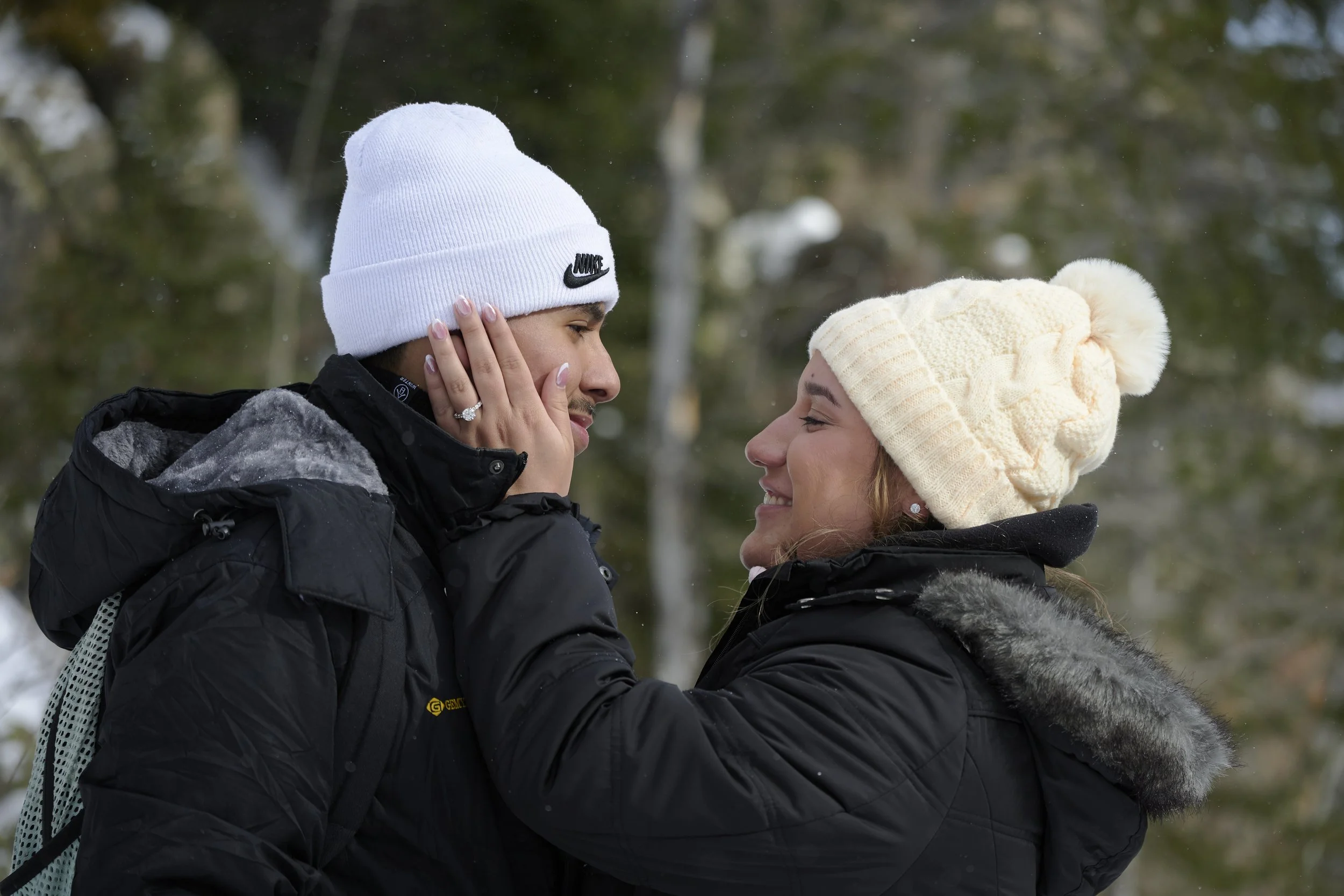
No need dress up for these engagement photos, it’ll be just the two of you on a beautiful hike ending at a wall of granite over beautiful green water. Since the park dropped its photography permit in 2024, an engagement shoot here needs nothing but a timed entry reservation and an early alarm.
Elopement Portraits
It doesn’t matter if you elope in Rocky Mountain National Park or in a nearby Estes Park venue, you can always choose to add on portraits at Emerald Lake. Just because you don’t actually say your vows here doesn’t mean you won’t get the photo you hang on your wall here. Check out our RMNP Elopement Guide to find out where you can actually get married in the park.
The Basics
Trailhead: Bear Lake parking lot
Distance: 1.8 miles each way (3.6 miles round trip)
Elevation gain: 605 feet
Starting elevation: 9,475 feet (Bear Lake trailhead)
Ending elevation: 10,080 feet (Emerald Lake)
Difficulty: Moderate
Time (one way): 45 to 75 minutes, depending on pace
Trail surface: Rocky, with sections of stone steps and roots
Winter conditions: Icy and snow-packed, microspikes required, very windy and cold at the cirque
At the Trailhead: Bear Lake is the busiest, most built-up trailhead in this corner of the park, with a staffed ranger station for current conditions, vault toilets, and a sizable lot that nonetheless tops out early, frequently by 6 or 7 a.m. in summer. Arrive ahead of that, or lean on the Park & Ride shuttle.
Timed entry, and the best time to go
Emerald shares the Bear Lake trailhead, which sits inside the park's strictly managed Bear Lake Road Corridor. For 2026, a Timed Entry + Bear Lake Road reservation is required to drive into the corridor between 5 a.m. and 6 p.m. from May 22 through October 18. You book it on Recreation.gov, where permits release about a month ahead (and again at 7 p.m. the night before), and you choose a two-hour entry window.
But there’s another way: enter before 5 a.m. and you skip the reservation entirely. For a summer sunrise shoot that's exactly the plan, roll through the entrance station in the dark, no permit needed, and you beat the crowds and the wind to the lake at the same time. If you'd rather sleep in, the free Park & Ride shuttle partway up Bear Lake Road gets you to the trailhead when the upper lot is full (you still need the corridor reservation to drive to the Park & Ride during timed-entry hours).
BONUS: SKIP THE DRIVE ENTIRELY
You can avoid driving into the park altogether by riding the free Hiker Shuttle from the Estes Park Visitor Center to the Park & Ride, then transferring to the Bear Lake route to reach the trailhead. The real perk: arriving by shuttle means no timed entry reservation is required, just a park pass and a $2 Hiker Shuttle ticket booked ahead on Recreation.gov. The one catch for this hike is timing, the morning departures start too late for a pre-dawn start, so the shuttle suits a relaxed mid-morning outing rather than a sunrise one. We lay out the full shuttle schedule, season dates, and booking steps in our Dream Lake guide.
As for timing: weekday and sunrise, every time. Weekdays are far quieter than weekends, and first light gives you the calmest water, the best glow on Hallett Peak, parking before the meltdown, and a hushed trail. By mid-morning in July, the cirque can be busy and breezy. Come early on a Tuesday and you may share it with a marmot.
The three lakes along the way
The Emerald Lake trail isn't just one destination. It's a sequence of three alpine lakes stacked at increasing elevations, strung together by dappled forest, some jaw dropping viewpoints, and a couple footbridges over a tumbling stream. The lakes get the attention, but the spaces between them are half the reason we shoot the whole way up (or down) rather than just the final destination.
The trail leaves Bear Lake and climbs steadily through dense subalpine fir and Engelmann spruce. For the first half mile it's all forest, and in the morning light pours through the trees in long dusty beams.
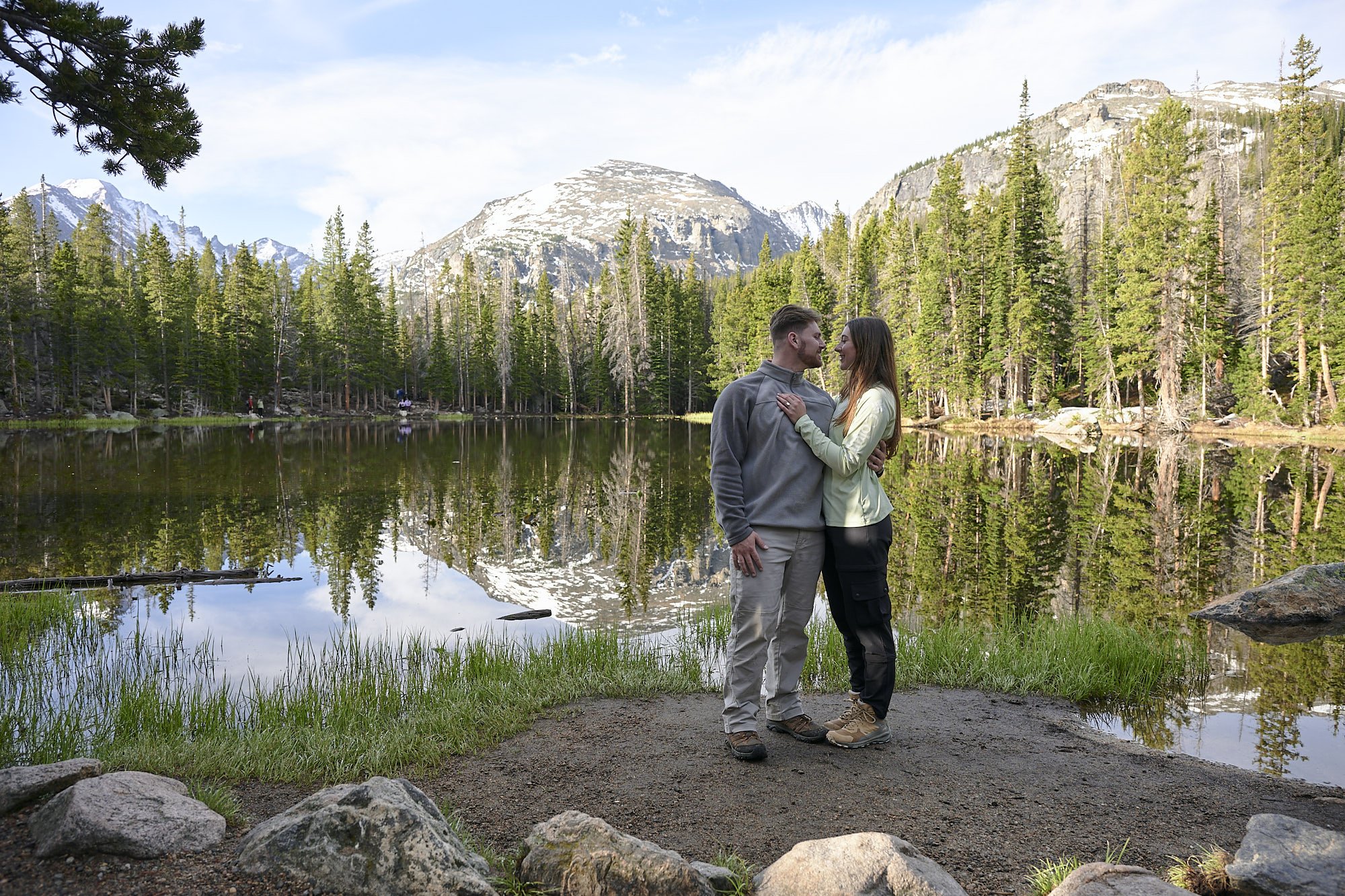
Half a mile in, the trees open onto Nymph Lake, at about 9,700 feet, the smallest of the three, ringed by lily pads in summer and looking like something out of a storybook, with views back toward Longs Peak. Most couples stop for a few quick frames before the climb steepens. Just above Nymph the trail switchbacks up an open shoulder, and this is the sleeper view of the whole hike: look back and you get Nymph below with Longs Peak and Glacier Gorge sweeping across the valley, the best wide, environmental frame on the route, the kind where you and the mountains share the picture. It's worth slowing down for rather than barreling through to the lakes.
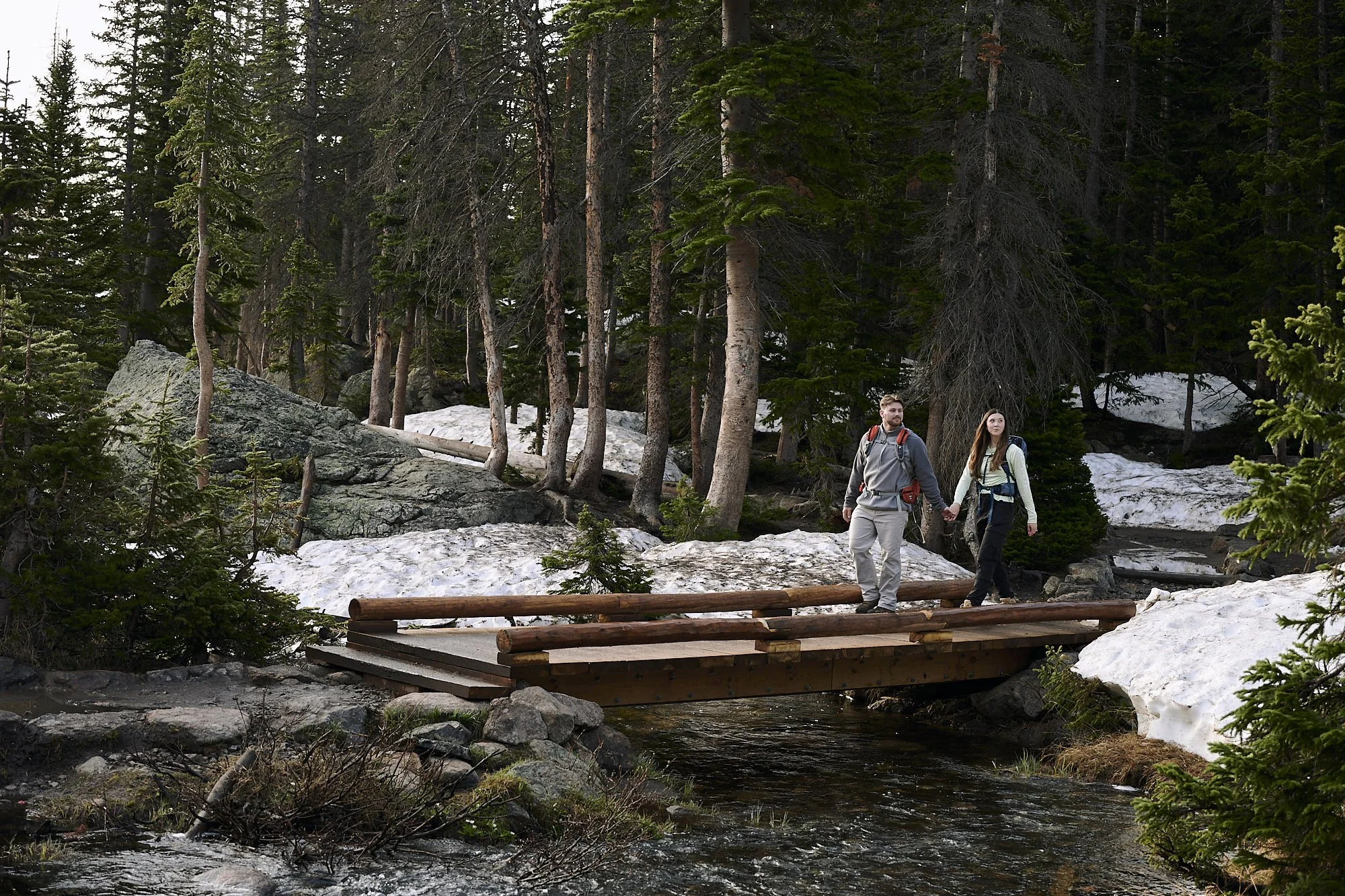
A little higher, the trail crosses the outlet stream on a small wooden footbridge, all running water and framing trees, a quiet, romantic spot almost everyone walks right over and we rarely do. Just beyond, at about 9,900 feet, is Dream Lake, the most-photographed lake on the trail, set in a long, narrow basin with Hallett Peak rising directly behind. The water is unbelievably clear and mirrors the peak on calm mornings, and some of our favorite portraits anywhere on this route come from its shore.
From Dream, the trail climbs another 0.7 mile through a boulder-strewn, increasingly rugged stretch (great for dramatic sense-of-scale frames) before cresting into the cirque at 10,080 feet. You emerge from the trees to see Emerald Lake, a small alpine lake walled in by Hallett Peak and Flattop Mountain, with the green tint that gives it its name. The shore is rocky, the mountains are huge, and the photos are stunning.
Is the last 0.7 mile worth it? Dream vs. Emerald
Because Dream Lake sits just below Emerald on the same trail, plenty of couples reach Dream and have to decide whether to keep climbing.
The final push to Emerald is short but distinctly rougher, a steeper, boulder-strewn grade that gains roughly 180 feet to the 10,080-foot cirque. What you receive for that effort is scale and drama. Where Dream opens into a calm, gentle basin, Emerald butts right up against the sheer walls of Hallett Peak and Flattop. It’s more enclosed, more imposing, more "we really earned this" setting. For an adventurous elopement or a couple chasing the most dramatic frame on the mountain, it's well worth the extra effort.
That said, Dream is the better stop for a flawless reflection, and the smarter turnaround if the wind is howling, the snow is deep, a storm is building, or someone's feeling the altitude.
Planning Your Adventure
Since you can't get married at Emerald, the question becomes: how do you fit the hike into your day? There are two main approaches that work, depending on your package and how much time you want.
The Same-Day Hike
Get married at one of the closer ceremony sites (Sprague Lake or Bear Lake), then drive to the Bear Lake trailhead and hike to Emerald the same day.
This works if:
You're getting married at sunrise (so there's time afterward)
You and your partner are reasonably fit
You have wedding clothes that move well or you're willing to change for the hike
The weather forecast is stable
A typical same-day timeline:
6:00 AM: Sprague Lake ceremony
7:30 AM: Drive to Bear Lake trailhead (10 minutes)
8:00 AM: Start hike
9:30 AM: Reach Emerald Lake, portraits
10:30 AM: Hike back, with stops at Dream and Nymph for more portraits
12:30 PM: Back at trailhead
1:30 PM: Lunch in Estes
The Two-Day Spread
Use day one for ceremony in the park or at a local venue in Estes Park and use the second day for an adventure session in you wedding clothes or more appropriate hiking attire.
This is the better fit for couples who:
Want serious mountain photos but don't want to get the dress dirty before the ceremoney
Have a guest list that includes non-hikers
Want a more relaxed pace or time spent with just each other
Are doing a microwedding at an Estes venue rather than a park ceremony
Our Summit package is built around this two-day option.
WORTH A READ
For full details on the Summit package and the two-day spread, see our elopements page.
The seasons, and why we love all of them
There's no bad season in this cirque, only different ones.
Summer (late June to early September)
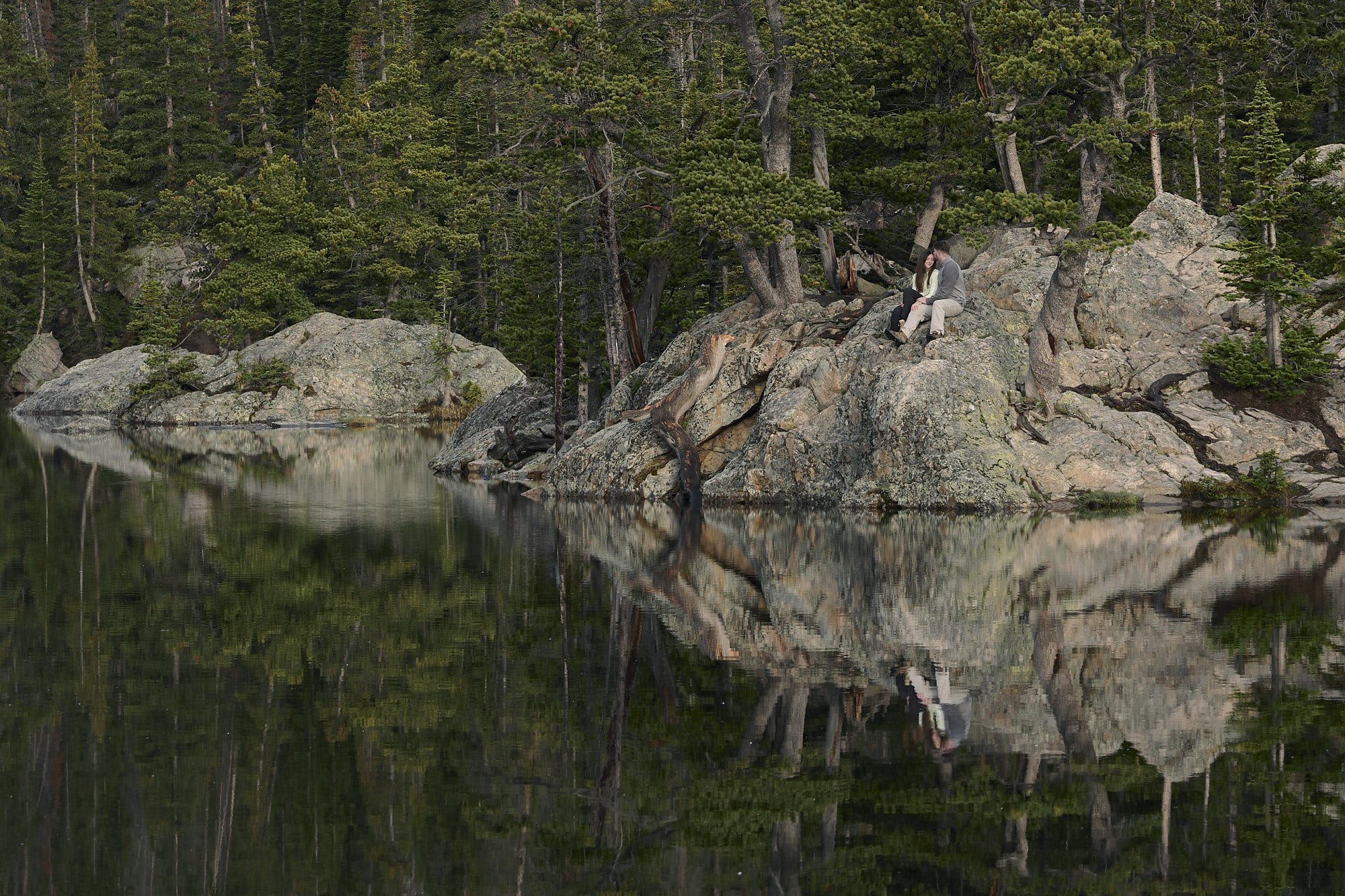
Summer is high season in Rocky Mountain National Park. This time of year is the most crowded (200 to 500 hikers at peak times) and the most weather-prone: afternoon thunderstorms build fast and turn genuinely dangerous above treeline, so we go early and head down by late morning. The payoff though is the lush green forests with wildflowers popping up through the rocks and dirty. We advise and early start both for the crowds and the weather since wind rises through the day and ruffles the water at the cirque and brings in the storms. It’s also a good idea to bring a an extra layer even in July; Emerald can be fifteen degrees colder and a great deal windier than the trailhead.
Fall (mid-September to mid-October)
When the summer crowds thin after Labor Day, mornings turn crisp and still (which means the year's cleanest reflections at Dream below), and the first snows powder the peaks behind Emerald. You can sometimes hear elk bugling across the valleys at dawn (although admittedly the sound is a bit spooky).. The trailside forest stays evergreen rather than gold, but the light goes long and amber and the park settles into an off-season calm.
Late fall (mid-October to mid-November)
During this in-between season, the trail becomes snow dusty and icy while the lakes begin to freeze. The crowds nearly disappear and the park as a whole is a lot quieter. This time of year is a lovely option for couples who want an empty-trail feel without committing to full winter. Although it’s definitely time to start packing microspikes and really focusing on bundling up.
Winter (December to April)
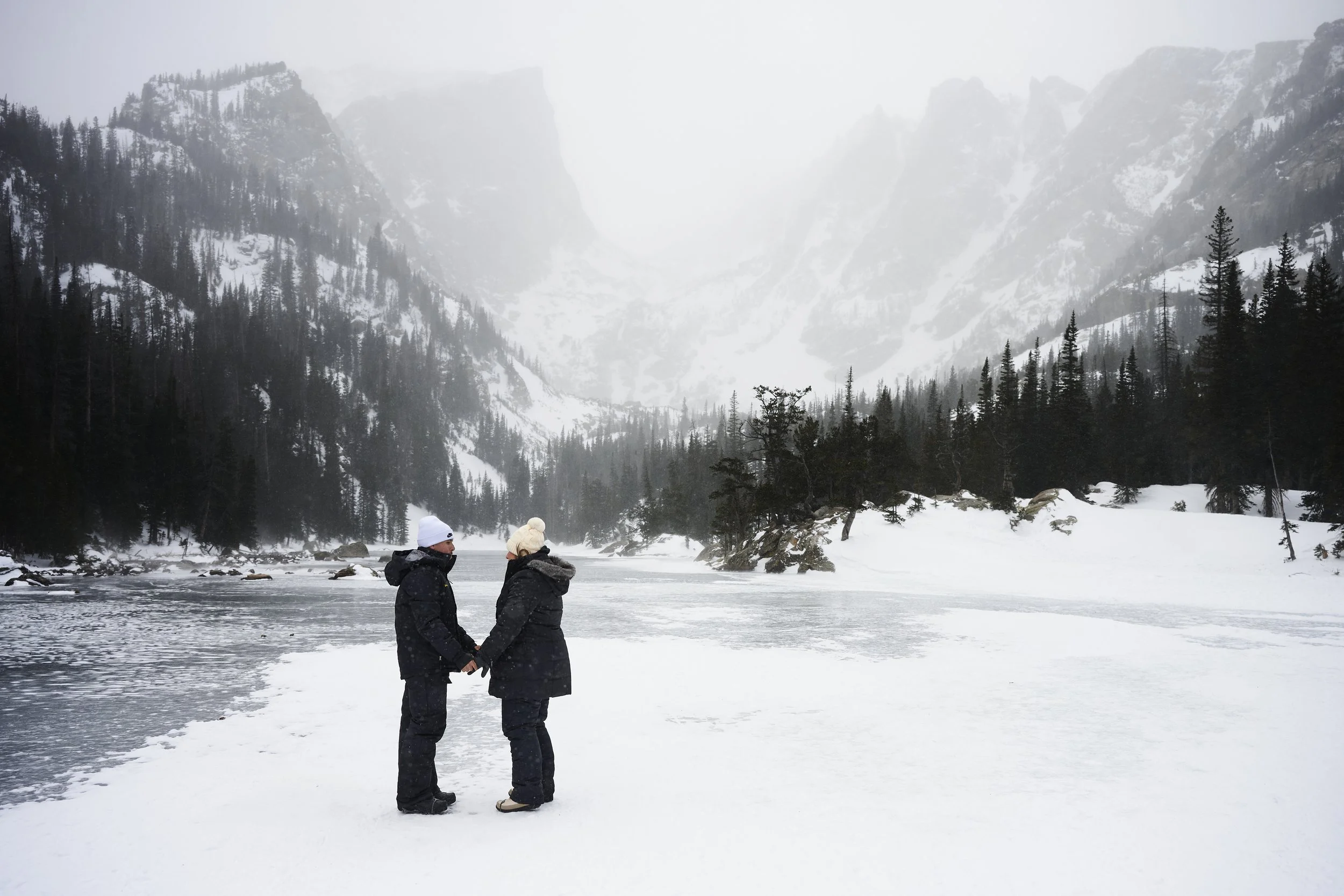
In the hear too winter Emerald and Dream freeze solid, the valley fills with snow, and on a clear day the cirque glitters like the inside of a geode. It's also the most demanding time of year to hike the trail: the trail is snow-packed at best, and requires post holing at worst (microspikes are definitely required). Snow depth varies wildly throughout the season and from year to year. The hike can take twice as long as it would in summer since snow can bury the trail and the wind can be so strong it pushes you back. This is the time of year where it becomes really important to plan your outfits carefully.
Spring (April to early June)
Spring is unpredictable. Snow can linger deep into May, the trail turns to mud and slush as it melts, and the lake can stay frozen past when the calendar insists it's spring. (Although you should definitely not trust the ice at this point.) This is the least reliable season for anticipating what your photos will look like, but when conditions cooperate, frozen-and-thawing water, snow-capped peaks, and almost nobody around, it's quietly spectacular. We watch the weather with an extra careful eye and always come with contingency plans in Spring.
The locals: a word on wildlife
Part of the reward for the climb is the company you keep along the way. Lower down, mule deer move through the forest, and out along Bear Lake Road elk gather in the meadows, the bulls filling autumn dawns with that strange, carrying bugle. Now and then a moose stands in the willows of the wetlands below, vast and serene, and earns a very wide, very respectful berth.
The higher you climb, the more the true high-country residents take over, and that's what sets Emerald apart from the lakes below. Chipmunks and golden-mantled ground squirrels patrol the rocks, bold as anything and never to be fed however hard they lobby, but up here it's the alpine specialists that steal the show: yellow-bellied marmots flopped across sun-warmed boulders like small, smug bears, and pikas rocketing through the talus with mouthfuls of wildflowers, squeaking all the way. Watch for Clark's nutcrackers prying seeds from the pines, gray jays angling for your trail mix, Steller's jays in flashing blue, and, where snow lingers late, a white-tailed ptarmigan hiding in plain sight. A full cast, just not a human one.
WORTH KNOWING
Keep your distance from everything with fur or feathers, and never share food. It's both harmful to the wildlife and illegal in the park. Give elk and moose an especially wide margin during the fall rut and spring calving, they might look serene, but they can be agg
What to wear and bring
This is the most important section for couples planning Emerald Lake portraits. The trail is real hiking. The wrong outfit can turn a beautiful idea into a rough day.
Footwear
Hiking boots or trail runners. Both partners. The trail is rocky with stone steps and exposed roots. Heels, flats, and most dress shoes will turn an ankle. (And in winter, cause you to slip and fall.) For couples who want bridal portraits in heels at the lake, the move is to hike in hiking boots and change at the destination.
Dress and suit considerations
The dress should either be:
One you don't mind getting dirty
Or short enough to clear the ground
Or a backup hiking outfit, with the dress carried up in a garment bag
For suits: leave the jacket in a pack until you're at the lake. Hike in a base layer.
Layers
The lake sits at 10,080 feet. The temperature drops noticeably between the trailhead and Emerald, often by 10 to 15 degrees. Wind picks up at the cirque. A light insulating layer is critical even in summer.
Other gear
Water (at least 1 liter per person)
Snacks (the hike burns more calories than you expect at altitude)
Sun protection (UV is intense at elevation)
A small daypack to carry your wedding clothes, bouquet, and any swap-in shoes
Headlamps if you're starting in the dark
Microspikes (winter and shoulder seasons)
WORTH KNOWING
The bouquet survives the hike just fine if you wrap the stems in a wet paper towel and a plastic bag. You can strap it to your backpack to keep both hands clear.
Common mistakes
Trying to have a private vow exchange at Emerald. The most common one. Even a quiet, private vow reading at Emerald is a violation of park rules and a citable offense for you, your photographer, and your officiant. Save the vows for your permitted ceremony site.
Underestimating the hike. 1.8 miles sounds short. At 10,000 feet, in wedding clothes, with a 600-foot elevation gain, on rocky trail, it's a real hike. Plan for it like one.
Wrong shoes. Heels, flats, and street sneakers do not work on this trail. Your feet will hurt, you might roll an ankle or fall, and you’ll probably get blisters. Bring proper hiking footwear and change at the destination if you want bridal shoes in the photos.
Going too late in the day. Afternoon thunderstorms in summer roll in by 1 to 2pm and can put hikers in real danger above treeline. Plan to be heading down by noon and keep an eye on the forcast.
Bringing too many guests. Most guests don't want to do a 3.6-mile hike at altitude on a wedding day. The hike usually works best with just the couple, the photographer, and maybe one or two close friends or family who actively want to come.
Is the Emerald hike right for you?
Pick this if:
You want some of the most dramatic alpine photos available in RMNP
You and your partner are comfortable with moderate hiking
You're getting married at Sprague or Bear Lake (or doing a two-day spread with an Estes ceremony)
You can plan your day around early-morning timing
You're willing to invest in proper hiking gear for the day (particularly in winter)
Skip it if:
You or your partner don't hike
You have guests who want to be in your portraits but won't make the hike
You want a relaxed, low-effort wedding day
You're planning a winter wedding and don't have winter hiking experience
For couples who want similar imagery without the hike, Sprague Lake at sunrise gets you a Continental Divide reflection with no elevation gain. It's not Emerald, but it's still beautiful.
COMPARE
For an easier alternative with similar visual impact, see our Sprague Lake guide. Or for a slightly shorter version of this hike, stop at Dream Lake. Check out our Dream Lake guide.
Planning an Emerald Lake shoot?
Whether it's a sunrise proposal, an engagement session, or elopement portraits to hike to, send us a note. We'll talk through whether it fits your day, when to schedule it, the timed entry, and what to bring.
Frequently Asked Questions
-
RMNP only allows ceremonies at thirteen designated sites. Emerald isn't one of them. The park has the rule to protect the fragile alpine environment and to manage foot traffic on popular trails. The fine for an unauthorized ceremony applies to you, your photographer, and your officiant.
-
No photography permit. As of January 1, 2024, RMNP no longer requires one for couples taking portraits, so engagement shoots, proposals, and elopement portraits are all fine. You do, however, need a Timed Entry + Bear Lake Road reservation to drive into the corridor between 5 a.m. and 6 p.m. in season, unless you enter before 5 a.m.
-
For 2026, a Timed Entry + Bear Lake Road reservation is required from May 22 to October 18, between 5 a.m. and 6 p.m., booked on Recreation.gov (released about a month ahead, plus a next-day batch at 7 p.m. the evening before). The simplest way to skip it: enter the corridor before 5 a.m., which is exactly what we do for summer sunrise shoots. The free Park & Ride shuttle is the backup when the Bear Lake lot is full.
-
Absolutely, and it's one of our favorite spots for both. Engagement sessions need no formalwear and no permit beyond timed entry. For a surprise proposal, tell us (not your partner), and we'll be positioned discreetly at the lake, ready for the moment, then roll straight into a celebratory session while you're both glowing. Sunrise on a weekday gives you the privacy and the light.
-
Yes, but it requires real winter hiking experience. Microspikes are required, the trail can be hard to follow under snow, and the lake itself is frozen. We don't recommend it for couples in formal attire or without prior winter hiking experience.
-
Sure, if they want to and they're up for it. Most don't. The hike usually works best as a small-group activity (couple plus photographer plus 1 or 2 close people).
-
Great option. Dream Lake is shorter (1.1 miles each way), still has the iconic Hallett Peak reflection, and most couples find it more photogenic than Emerald itself. If the Emerald hike feels like too much, stop at Dream and turn back. Check out our Dream Lake Guide.
-
Sunrise. The trail is quietest, the light is best, and you're off the trail before afternoon weather hits. Plan to start the hike about 30 minutes before sunrise.
-
Turn around whenever you need to. Dream Lake is a perfectly good destination on its own, and Nymph Lake (just half a mile in) has its own character. There's no failure mode here.